News
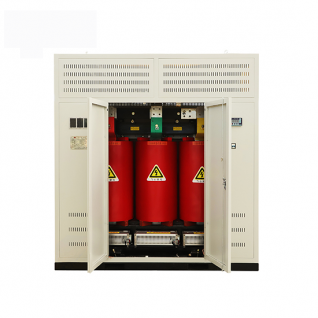
Looking for a dry-type transformer that is safe, maintenance-free, and suitable for indoor installations? Unlike oil-immersed transformers, dry-type transformers eliminate fire and leakage risks, making them the preferred choice for commercial buildings, hospitals, data centers, and industrial facilities with strict safety requirements.
The core and windings are directly exposed to the surrounding air. Designed for clean, dry rooms (ambient temperature 20°C, relative humidity ≤85%). Cooling methods: AN (Air Natural, self-cooling) or AF (Air Forced, fan cooling).
Fully enclosed in a sealed housing, isolated from the atmosphere. Mainly used in mining as explosion-proof transformers. However, sealing limits heat dissipation, so we rarely use this type for general applications.
Uses epoxy resin or other resins as the main insulation. Simple structure, compact size. Suitable for small-capacity transformers (e.g., indoor distribution).
| Cooling Method | Operation | Capacity |
|---|---|---|
| AN (Air Natural) | Natural convection, no fans | Rated capacity (100%) – continuous operation |
| AF (Air Forced) | Forced air cooling with fans | Up to 150% of rated capacity – for intermittent overload or emergency use |
⚠️ Important: Under AF overload operation, load loss and impedance voltage increase significantly, making it less economical. Therefore, do not use forced air cooling for long-term continuous overload.
| Advantage | Benefit |
|---|---|
| No Fire or Explosion Risk | Dry-type transformers use flame-retardant insulation materials. Even if a failure occurs or an external fire source exists, the fire will not spread. |
| No Oil Leakage & No Oil Aging | Eliminates environmental contamination risks and the need for oil sampling, filtering, or replacement. |
| Low Maintenance – Almost Maintenance-Free | Greatly reduces operation, inspection, and maintenance workload compared to oil-immersed units. |
| Space-Saving Indoor Design | Typically designed for indoor installation. Can be placed in the same room as switchgear, reducing the overall installation footprint. |
| Fewer Accessories, No Sealing Issues | No oil conservator, no safety airway, no large number of valves – fewer potential failure points and lower long-term costs. |
Contact a Xinghe representative today to learn more about our Transformer.